
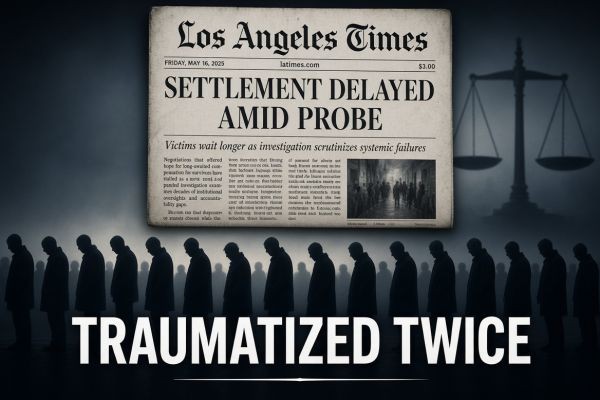
In April 2025, Los Angeles County approved a historic $4 billion settlement to resolve more than 10,000 claims of childhood sexual abuse in county-run juvenile facilities, foster homes, and the former MacLaren Children’s Center. A second settlement of $828 million followed later that year. These agreements were the result of years of lawsuits enabled by California’s AB 218, which temporarily lifted the statute of limitations.
LA Times reporter Rebecca Ellis has been the primary journalist covering both the settlement and the subsequent fraud allegations. Her reporting identified individuals who said they had been paid by recruiters to file claims, including some who stated they fabricated allegations. That work contributed to a criminal investigation by the Los Angeles County District Attorney’s Office, a State Bar inquiry, additional claim vetting by a retired judge, and repeated delays in the distribution of settlement funds.
The District Attorney’s Office has publicly claimed that fraud indicators appear in a large percentage of certain claims. A Superior Court judge rejected a request to freeze the entire payout, but payments to clients of some of the largest law firms involved have still been paused or slowed pending audits. As of September 2026, many survivors who signed settlement documents more than a year earlier had still not received the funds they were told were coming.
There is a legitimate public interest in preventing taxpayer money from going to fabricated claims. Exposing recruitment schemes and false filings protects the integrity of the process and, in theory, preserves more money for people with genuine claims.
What has received far less sustained attention is the human cost of the resulting delays. Survivors whose claims were never accused of fraud are being traumatized a second time — first by the original abuse inside county institutions, and now by a process that treats them with suspicion while their promised compensation remains out of reach. Attorneys representing claimants have stated in open court that some clients are in severe financial hardship and that further postponements risk people dying before they are paid. Many describe heightened stress, worsening health, and the feeling that the system that was supposed to deliver accountability is instead blaming the victims for the actions of a minority of bad actors.
The coverage pattern has been consistent: detailed, repeated examination of alleged fraud and the investigative response, with comparatively less focus on the secondary victimization caused by payment freezes and prolonged uncertainty. The result is that legitimate survivors — the majority of claimants, according to the attorneys who represent them — have been left in limbo while the system sorts out the bad actors. In the process, the original harm is compounded by a new layer of institutional distrust and financial desperation.
A settlement of this size was always going to attract scrutiny. The question is whether the reporting and official response have adequately balanced the need to root out fraud against the duty not to re-harm people who already waited decades for any form of accountability. So far, the balance has tilted heavily toward the former, and the people still waiting for their checks are paying the price — again.